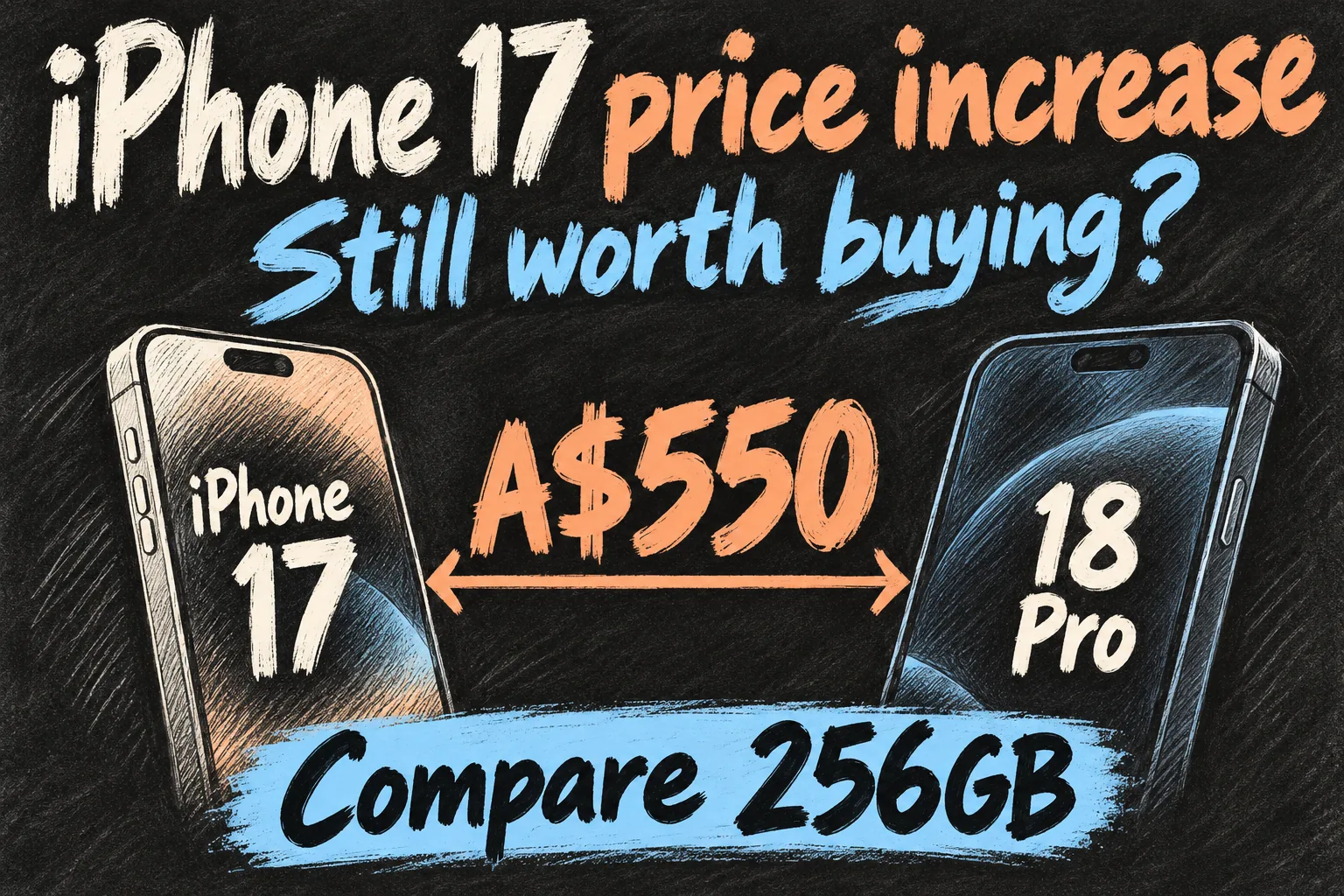
Despite the iPhone 17 price increase, choose the standard 17 for everyday use when you do not need a dedicated telephoto camera or a professional recording workflow. Consider the iPhone 18 Pro when those capabilities solve a recurring problem worth the additional cost.
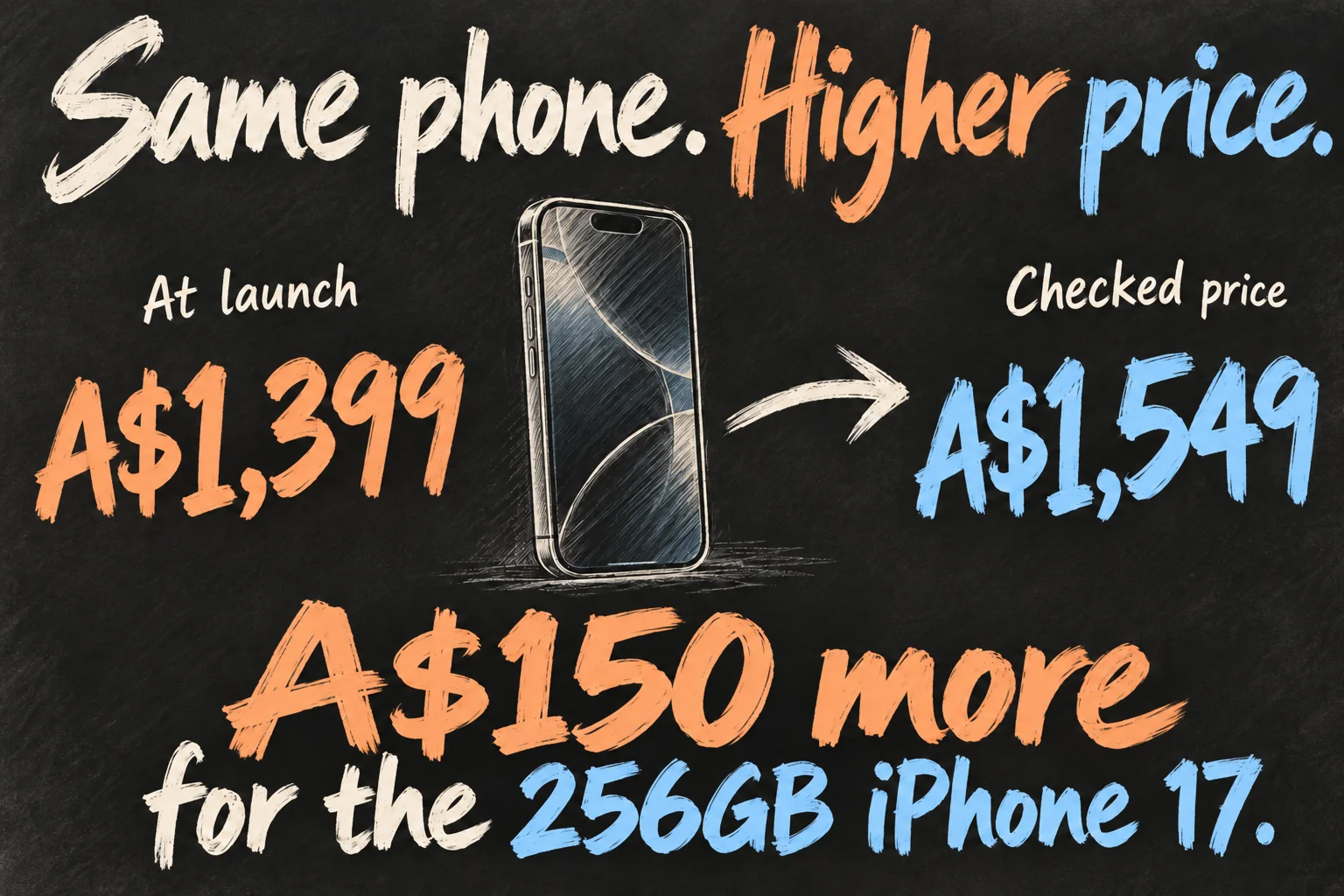
Apple Australia’s 256GB iPhone 17 was A$1,549 when checked on 11 October 2026, up from A$1,399 at launch. The same-capacity 18 Pro was A$2,099: an A$550 gap. This research-based guide compares what that gap buys at Australian prices including GST; it is not a hands-on test.
What changed in the iPhone 17 price increase?
Apple announced the standard iPhone 17 in September 2025 with a starting Australian price of A$1,399 for 256GB. Its current store price is A$1,549: an increase of A$150, or approximately 10.7%. You are paying more for the same model, rather than receiving extra storage with that increase.
The comparison is specifically between the standard 17 and the smaller 18 Pro. It does not compare the 17 Pro, 17e or 18 Pro Max. Those names can lead to very different prices and buying decisions.
It is tempting to assume last year’s phone must be cheaper after a launch. The iPhone 17 price increase shows why you should check today’s price instead. An old review’s recommendation may still describe the hardware accurately while using a price you can no longer obtain from Apple.
iPhone 17 price in Australia: how much do you actually save?
For an iPhone 17 vs iPhone 18 Pro comparison, match storage before comparing the bill. Here are Apple’s outright Australian prices at the time of checking, with no trade-in credit or mobile service plan included.
| Storage | iPhone 17 | iPhone 18 Pro | Save with 17 |
|---|---|---|---|
| 256GB | A$1,549 | A$2,099 | A$550 |
| 512GB | A$1,949 | A$2,499 | A$550 |
Source: Apple Australia, checked 11 October 2026. Prices include GST; outright purchase without trade-in or a mobile plan.
You save A$550 with the 17 at either shared storage tier. That is about 26.2% of the 256GB Pro’s price. Put another way, the Pro costs about 35.5% more than the 256GB 17. Those percentages use different starting amounts; they should not be presented as interchangeable discounts.
Spread A$550 over four years of ownership and the difference is about A$11.46 a month. That is a budgeting illustration, not a finance offer. It can make the premium easier to assess, but it does not reduce the amount you pay.
There is also a useful cross-storage comparison: the 512GB 17 costs A$150 less than the 256GB 18 Pro. If storage is your recurring frustration and advanced camera features are not, more capacity may solve your problem better than a Pro badge. Check your current storage use before choosing.
What do you keep by choosing the cheaper phone?
The strongest argument for the 17 is its display: 6.3-inch OLED with adaptive ProMotion up to 120Hz. The 18 Pro also has a 6.3-inch OLED display with ProMotion. You do not have to buy the Pro simply to get smooth scrolling.
For messaging, maps, browsing and watching videos, that shared feature changes the value equation. Spending more should address a specific limitation you have, rather than an assumption that the standard model has an outdated screen.
The 17 also offers a 48MP main camera and a 48MP ultra-wide camera, plus 4K Dolby Vision recording up to 60fps. For everyday family pictures and short social videos, those are substantial capabilities. Camera specifications alone do not prove equal image quality, but they explain why the less expensive model remains a credible option.
If your photos are mostly taken close to the subject, consider how often you actually need longer reach. Your own photo habits are more useful than choosing whichever model has the longest feature list.
When is the iPhone 18 Pro worth another A$550?
The camera system is the clearest reason to move up. The Pro adds a dedicated 48MP 4x telephoto camera, optical-quality 8x framing and a variable-aperture main camera. The 17’s optical-quality 2x option comes from its main camera; it is not a separate telephoto lens.
For someone repeatedly photographing distant subjects at events or while travelling, reach can affect which pictures are practical. However, a larger zoom number does not guarantee sharp results in every lighting condition. We have not conducted a side-by-side camera test.
Recording and editing needs are another dividing line in iPhone 17 vs iPhone 18 Pro. ProRAW and ProRes support can matter if you deliberately capture files for later editing. If you use the default camera mode and share straight to social media, ask whether you would actually adopt that workflow before paying for it.
Apple lists up to 34 hours of video playback for the 18 Pro, compared with 30 hours for the 17. These are manufacturer test figures, not a promise of four additional hours during your normal day. They also must not be confused with the larger Pro Max’s 43-hour figure.
For a broader look at the Pro’s purchase case, read our iPhone 18 Pro buying guide for Australia.
Is iPhone 17 worth buying at full price or only on sale?
At full price, the 17 remains defensible when you need a replacement now and would rarely use the Pro’s extras. The iPhone 17 price increase makes the purchase less attractive than it was at launch, but it has not removed the A$550 gap.
A genuine retailer discount improves that argument. For illustration, a 256GB 17 offered at its old A$1,399 price would save A$700 against Apple’s current 256GB Pro price. That is a hypothetical comparison, not a verified live deal. Compare the actual checkout totals for both phones when you shop.
Do not mistake a trade-in allowance for an unconditional discount. Likewise, a cheap monthly handset price may require a service plan you would otherwise avoid. Add the device payments and required plan charges across the full term, then compare with buying outright and keeping your preferred plan.
Check the exact capacity, seller, new or refurbished condition, local warranty arrangements and return terms. A lower advertised price is useful only when the offer matches what you intend to buy.
Who should buy each model—or keep their current phone?
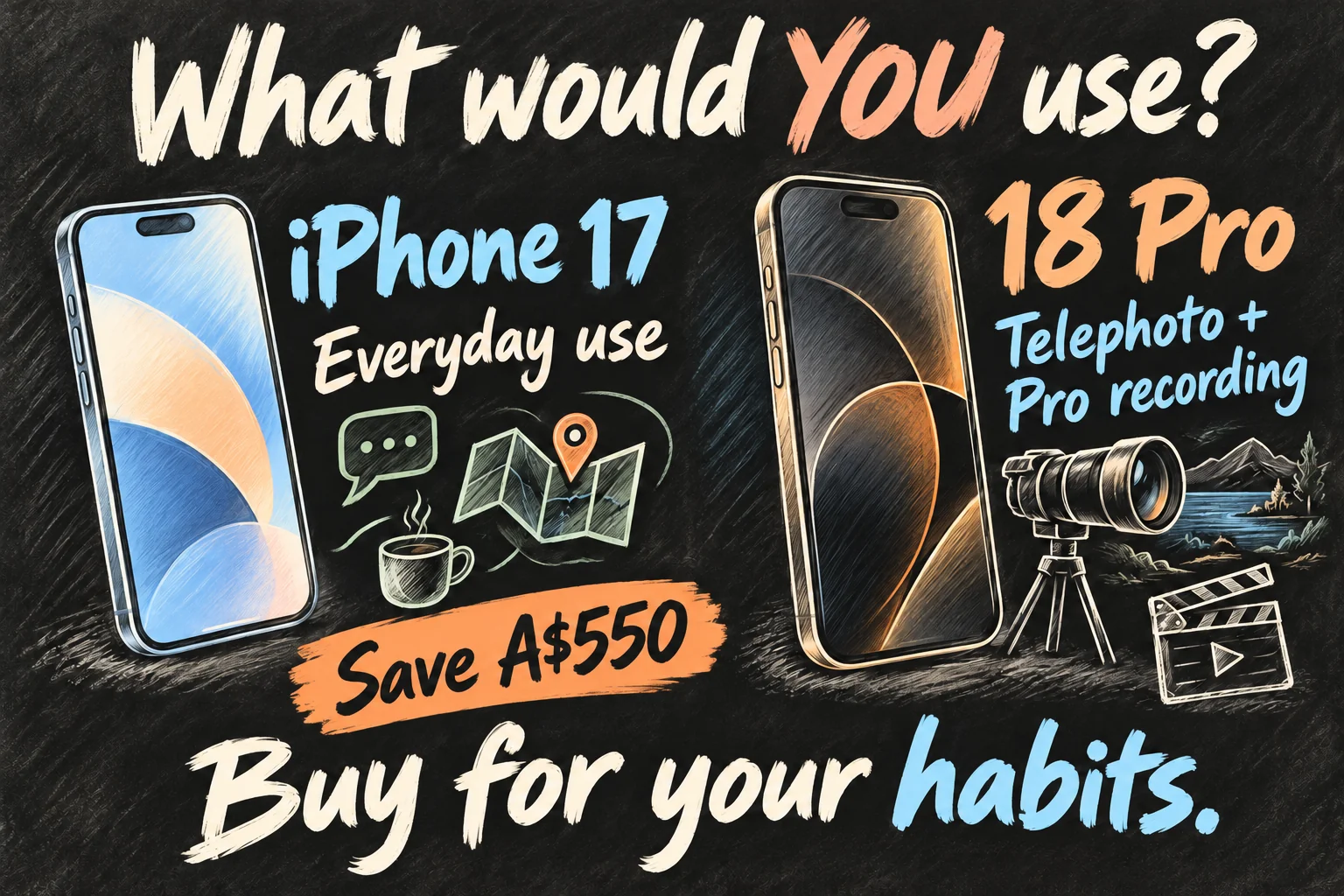
Choose the 17 if your priority is a modern everyday phone and keeping A$550 in your budget. A useful test is to name a Pro-only feature you would use each week. If you cannot, the cheaper model deserves serious consideration.
Choose the 18 Pro if longer-reach photography or an editing workflow is already part of your routine. Paying for a capability you repeatedly need is easier to justify than paying for an option you might use one day.
Keep your current phone if it still handles your needs reliably. If battery life is the only problem, investigate a battery-service quote before replacing the entire device. An iPhone 17 vs iPhone 18 Pro decision does not have to end in a purchase.
Is iPhone 17 worth buying? For an everyday user who needs a new phone, yes—with today’s price and the compromises clearly understood. The recommendation changes if the actual retailer price gap narrows, or if your camera needs extend beyond what the standard model offers.
For a related practical guide, read iPhone 18 Pro in Australia: Is It Worth A$2,099? or iPhone 18 Pro vs Pro Max: Is Bigger Worth A$200 More?.
FAQ
Q. How much did the iPhone 17 price increase in Australia?
The 256GB standard model rose from A$1,399 at launch to A$1,549 in Apple’s current Australian store, a difference of A$150. Both amounts include GST. This comparison was checked on 11 October 2026.
Q. Does the iPhone 17 have a 120Hz screen?
Yes. It supports adaptive ProMotion up to 120Hz. Choosing the standard model does not mean giving up that feature, although actual refresh rate varies with content and conditions.
Q. Is iPhone 17 worth buying instead of the 18 Pro for photography?
It is a reasonable choice when you mainly use the main and ultra-wide cameras. The Pro is more compelling when you regularly need a dedicated telephoto lens or advanced capture formats. This guide does not claim that their camera results are identical.
Q. Which iPhone 17 price in Australia should I compare with a deal?
Use the current price for the same capacity and condition, then check the final amount payable. At the time of checking, Apple’s 256GB and 512GB prices were A$1,549 and A$1,949 respectively. Other sellers and countries can differ.
Sources and Reading Notes
Apple Australia: iPhone 17 launch announcement, current iPhone 17 and iPhone 18 Pro purchase pages, and both models’ technical specifications. These establish the launch price, current Australian prices and manufacturer-listed features. Checked 11 October 2026.
TechRadar: iPhone 18 Pro vs iPhone 17 comparison. WhistleOut Australia: reporting on older-iPhone price changes. Tom’s Guide: a contributor’s experience moving from a 15 Pro Max to a standard 17. These provided comparison context; their hands-on experiences are not our own. Current prices in this guide follow Apple rather than older third-party price listings.
This article combines published information with our buying analysis. Illustrations explain price arithmetic and decision criteria; they are AI-generated graphics, not product photos or camera samples. Retailer discounts and four-year cost examples are clearly labelled illustrations rather than live offers or financing quotes.
Prefer reading about Apple in Korean?
 Apple-worldApple news, tips and buying guides in Korean.blog.naver.com/apple-world ↗