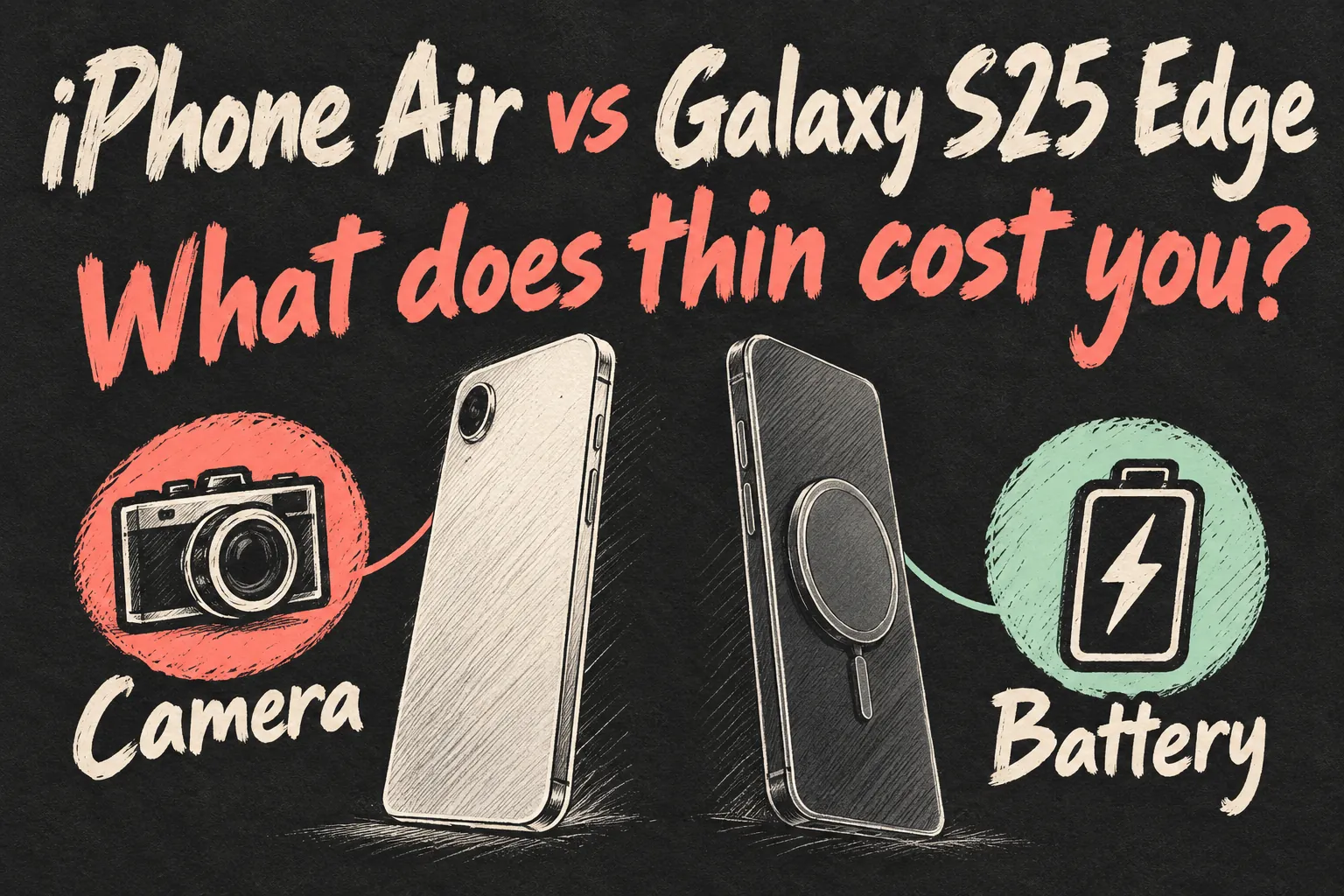
The iPhone Air vs Galaxy S25 Edge choice is about which compromises you can live with. Choose Air if you want a slim iPhone with built-in magnetic charging and your everyday workflow already suits iOS. Choose Edge if an ultrawide camera, stereo speakers and a physical SIM matter more. If long gaming sessions, distant zoom shots or maximum battery reserve are essential, compare conventional flagship models before paying for thinness.
Neither phone wins simply by being thinner. Air has the slimmer body; Edge is slightly lighter and offers the larger screen. The useful question is what you would actually miss after switching, especially once you add a case or battery pack.
Checked 19 October 2026. This guide compares the original iPhone Air with Samsung Galaxy S25 Edge, not a rumoured Air successor. It is based on official Australian specifications and attributed published tests, not our own hands-on measurements. Australian prices below distinguish a current store listing from launch RRP. Illustrations are concepts, not official photographs.
iPhone Air vs Galaxy S25 Edge: essential specs
| Specification | iPhone Air | Galaxy S25 Edge |
|---|---|---|
| Body thickness / weight | 5.64mm / 165g | 5.8mm / 163g |
| Display | 6.5-inch OLED; up to 120Hz | 6.7-inch QHD+ AMOLED; 1–120Hz |
| Processor | A19 Pro, 5-core GPU | Snapdragon 8 Elite for Galaxy |
| Rear cameras | 48MP main; 2x sensor crop | 200MP main + 12MP ultrawide; 2x sensor crop |
| Dedicated telephoto | No | No |
| Storage | 256GB, 512GB, 1TB | 256GB, 512GB |
| SIM arrangement | eSIM only | Australian model: physical SIM + eSIM |
| USB data | USB 2, up to 480Mbps | USB 3.2 Gen 1 |
| Speaker arrangement | Single speaker | Stereo speakers |
These specifications explain the trade-offs, not a complete quality ranking. Megapixels do not measure the quality of a moving subject at night, and a processor name does not tell you how a game runs after half an hour. The next checks turn the table into a purchase decision.
1. Thinness and comfort: try the finished setup
The difference in advertised body depth is 0.16mm; the weight difference is 2g in Samsung’s favour. Those small gaps are a poor reason to change platforms. Camera protrusions also mean the headline depth does not describe every point on the back.
Try each phone with the protection you intend to buy. Open the keyboard, reach the top corner and hold it as you would on a train. A broader screen can help with reading, but it can also change your grip. A security tether on a shop display makes this imperfect; look for a return policy that suits your purchase if comfort remains uncertain.
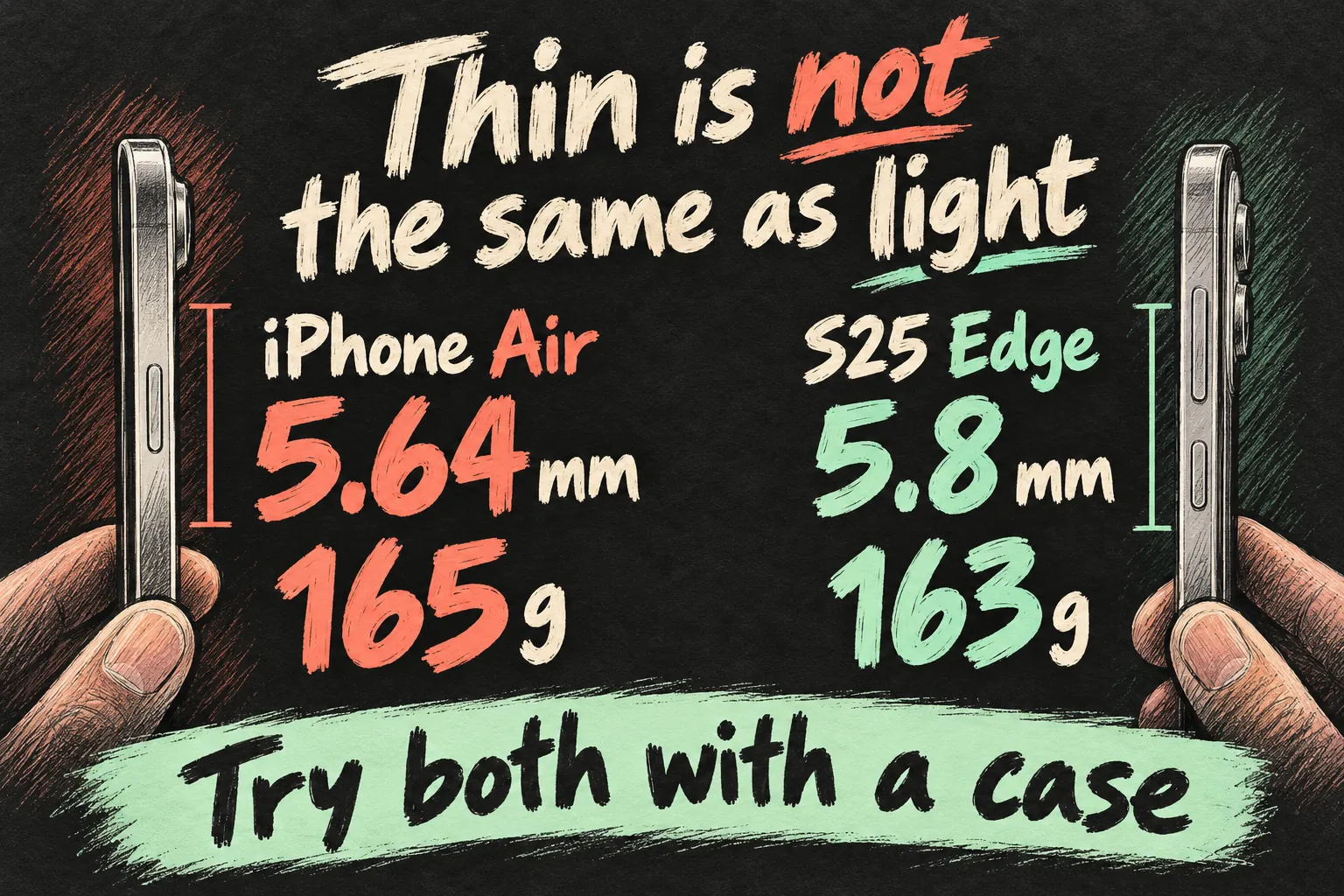
Do the same exercise with a battery attached if you expect to use one every day. You may still prefer the slim phone, but judge the size you will carry rather than the bare handset in an advertisement.
2. Cameras: the missing lens matters more than megapixels
The Galaxy S25 Edge camera system includes an ultrawide lens. That gives you an extra framing option for a group at a restaurant table, a small room or a building you cannot step far enough away from. Air has no rear ultrawide. If you frequently use 0.5x on your current phone, that is a meaningful feature to give up.
Both manufacturers describe a 2x optical-quality option from the main sensor. Neither phone has a separate telephoto lens. A sensor crop is useful, but it is not the same hardware arrangement as a dedicated long lens. Do not choose either expecting the distant-subject flexibility of a zoom-focused model.
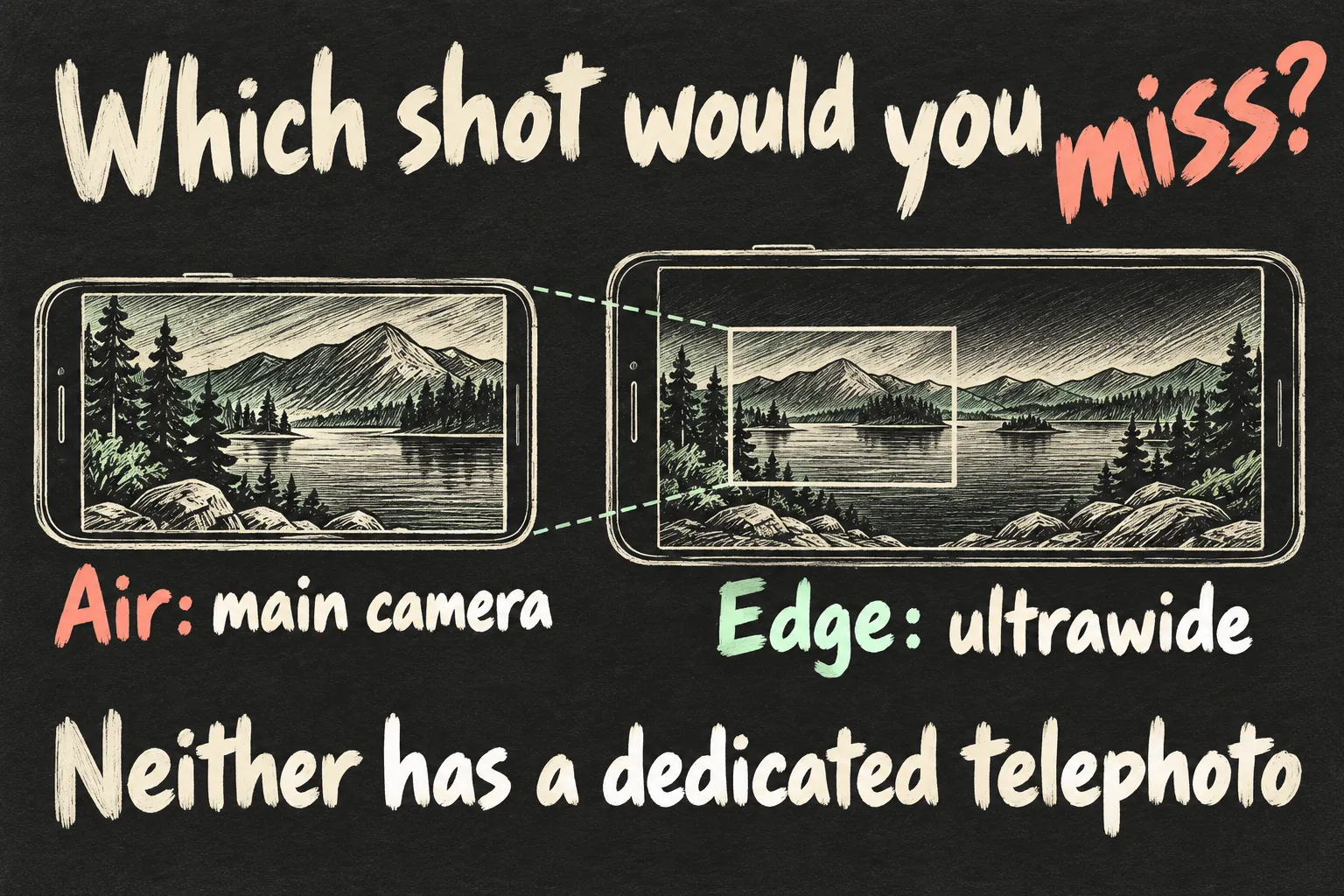
For the iPhone Air vs Galaxy S25 Edge camera decision, first check your own photo library. How many important pictures needed an ultrawide view? How many needed long zoom? Then compare review samples of faces, pets and evening scenes at a normal viewing size. A higher-resolution sensor is not a promise of better results in every scene.
3. Battery: match the test to your day
Tom’s Guide’s September 2025 comparison measured continuous web surfing at 150 nits. Air lasted 12 hours 2 minutes; Edge managed 11 hours 48 minutes. That 14-minute gap is small and belongs to that particular test, not every daily routine.
| PhoneArena published workload | iPhone Air | Galaxy S25 Edge |
|---|---|---|
| Browsing | 16h 29min | 16h 40min |
| Video | 9h 54min | 7h 44min |
| Gaming | 7h 27min | 9h 38min |
Source: PhoneArena’s comparison table, checked 19 October 2026. These are that publisher’s test results. They are not directly comparable with Tom’s Guide’s different protocol, and the gaming row is not a promise for every game or graphics preset. We use the measured table rather than the older speculative battery wording still present elsewhere on that page.
The practical lesson for iPhone Air battery life is that workload matters. Video and gaming do not produce the same winner here. Navigation on mobile data, a hotspot and background syncing can change the outcome again. Neither table establishes how much charge you personally will have at bedtime.
If you regularly finish the day close to empty, do not plan around the smallest laboratory lead. Budget for a convenient charging opportunity or compare a phone with stronger endurance in tests matching your own use. A slim phone becomes less appealing if carrying extra power feels like a daily obligation.
For charging, Apple advertises up to 50% in 30 minutes with a suitable adapter; Samsung advertises up to 55% in around 30 minutes with its specified 25W setup. These are separate manufacturer claims, not a controlled head-to-head result. Adapters and compatible accessories can add to the bill.
4. Everyday features: check SIM, magnets and file transfers
Air’s built-in MagSafe and Qi2 magnets make magnetic chargers and compatible accessories straightforward to attach. Edge has wireless charging but no built-in attachment magnets. Android Central highlights this distinction: a compatible magnetic case changes the accessory experience, as well as the finished thickness.
For Australian buyers keeping an existing physical SIM, Air requires an eSIM activation or transfer. Confirm support for your exact plan before buying, including any prepaid service or travel arrangement you depend on. The local Edge model supports physical SIM and eSIM. Overseas model specifications are not a substitute for checking the model actually being sold.
Edge also has the faster USB data specification. That is relevant if you regularly move large files with a suitable cable and computer; it has little bearing on uploading a photo over Wi-Fi. Air’s single speaker versus Edge’s stereo arrangement is another difference to try with a familiar video rather than assuming headphones will always be connected.
Finally, list the apps, watch, purchased software and account access you would need to move. A discount can be absorbed by replacing accessories or recreating a workflow. If you choose iPhone, our new iPhone transfer checklist covers the checks to make before erasing the old device, including a separate Android migration branch.
5. Australian pricing: use a live quote, not an old winner
Apple Australia showed A$1,899 for iPhone Air 256GB on 19 October 2026. Samsung’s Australian announcement lists A$1,849 for Edge 256GB, but that is its May 2025 launch RRP. We could not obtain a reliable current Edge checkout price from Samsung’s buying tool, so it is not presented as an available offer today.
Older comparisons describe Air as A$50 cheaper at launch. That historical value judgement does not establish today’s best buy. Get a current local-stock quote at matching storage, then compare the total you would actually pay. Do not subtract a trade-in headline unless your device qualifies and you are willing to surrender it.
For a carrier offer, include the required plan cost over the full commitment, not just the monthly handset discount. For a retailer offer, check the exact model, local warranty arrangements, condition and delivery date. A refurbished or imported unit should not silently be compared with a new Australian retail phone.
Our iPhone Air vs Galaxy S25 Edge buying order is must-have features → comfortable setup → battery fit → total local price. At similar final prices, favour the platform and features you will use daily. A large genuine discount can change the value calculation, but it cannot add a missing lens or SIM slot.
Which slim phone should you buy?
Choose Air if keeping iOS and magnetic accessories makes daily life easier, and you are comfortable with the camera and speaker compromises. Confirm eSIM support before payment. Treat a future Air model as a separate buying question rather than assuming unannounced improvements are included here.
Choose Edge if an ultrawide camera, stereo sound, physical-SIM flexibility or wired file transfers are features you would miss. Confirm the current selling price and availability. Its extra hardware options are useful only if you want the Android workflow that comes with them.
Choose neither automatically if you mainly want the best battery or camera system for your money. The iPhone Air vs Galaxy S25 Edge comparison concerns two design-led phones. A slightly thicker handset may better solve your actual problem without an accessory workaround.
FAQ
Q. Which is thinner: iPhone Air or Galaxy S25 Edge?
Air’s advertised body depth is 5.64mm against 5.8mm for Edge. Edge is slightly lighter at 163g versus 165g. Camera protrusions and cases affect the complete shape you carry.
Q. Does the Galaxy S25 Edge camera have a zoom lens?
It has a main camera and an ultrawide, but no dedicated telephoto. Its advertised 2x optical-quality option uses the main sensor, as does Air’s 2x option.
Q. Is iPhone Air battery life better than Edge?
It depends on the workload. The published tests above show a small web-surfing gap in one protocol and different video and gaming winners in another. Match the test to your activity instead of comparing capacity alone.
Q. Can I put my current SIM card into iPhone Air?
No physical SIM card fits Air. Your provider must support a suitable eSIM setup for your plan. Check activation and travel requirements before moving your number.
Sources and Reading Notes
Apple Australia: iPhone Air technical specifications and 256GB Sky Blue store listing. Samsung Australia: Galaxy S25 Edge specifications, Australian-model business specification page and 13 May 2025 launch announcement. Prices and product information checked 19 October 2026. The Apple figure is a current listing; Samsung’s quoted figure is historical launch RRP.
Tom’s Guide: September 2025 head-to-head web-surfing test and methodology. PhoneArena: workload-specific battery table and audio discussion. Android Central: accessory, connectivity and hardware comparison. Pickr’s September 2025 Australian preview was reviewed for search benchmarking and launch context, not treated as an Air hands-on battery test. Recommendations here are our analysis of published evidence; we did not perform these measurements.